Otto Schlüter (✝︎)
XXI. President of the Leopoldina (1952-1953)
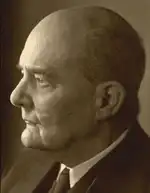
- Location Halle (Saale), Germany
- Election year 1923
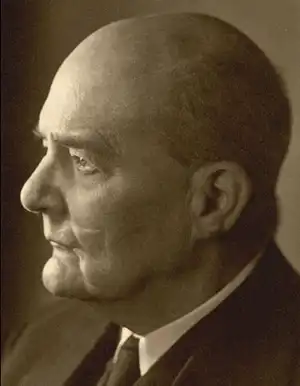
Research
Otto Schlüter was a German geographer. He made numerous contributions to the theoretical and methodological foundation of anthropogeography, particularly with regard to human settlement studies. As researcher and 21st President of the Leopoldina he played a vital role in the promotion of science in Germany.
His contributions to uncovering the origin of Central Europe’s cultural landscape laid the foundation for numerous area studies. Schlüter was also instrumental in advancing regional studies in the Central German region, as evidenced by his publication of the “Atlas des Saale- und mittleren Elbegebietes” (Atlas of the Saale and central Elbe area). From 1911 to 1951, he was key in shaping the teaching of geography at the Martin Luther University Halle-Wittenberg.
In addition, he acted as responsible Vice President (1945 to 1952) and 21st President of the Leopoldina (1952 to 1953). During his term, he managed to safeguard the learned society’s independence from the state organs of East Germany.
Person
Otto Schlüter was born on 12 November 1872 to the solicitor and notary Reinhard Schlüter and his wife Berta, née Keller, in the German city of Witten. He was initially educated by private teachers. From autumn 1881, he attended secondary school in Essen, from which he graduated in 1891. Schlüter stated that his geography teacher had a profound impact on him.
In 1907, he married Margret, née Heyer. The couple had three sons, born in 1910, 1911 and 1913 respectively. The two younger sons died in 1941 while fighting on the Eastern Front during the Second World War. The eldest son later became the municipal architect of Hanover. Schlüter’s wife died in 1947. The family lived at Ulestraße 3 in Halle’s Paulusviertel district.
Otto Schlüter died on 12 October 1959 in Halle (Saale). His grave can be found in the cemetery of the St. Laurentius church.
A street on the Weinberg campus in Halle was named after Otto Schlüter.
Career
Otto Schlüter began his studies in geography, geology, mineralogy and philosophy at the University of Freiburg in 1891. A year later, he transferred to the Martin Luther University Halle-Wittenberg, where he earned his doctorate on 10 January 1906 with his thesis entitled „Siedlungskunde des Tales der Unstrut von der Sachsenburger Pforte bis zur Mündung“ (Human settlement in the valley of Unstrut from the Thuringian Gate to the mouth).
From 1898 to 1900, he was employed as an assistant at the Gesellschaft für Erdkunde zu Berlin (Berlin Geographical Society), while also serving as a lecturer at the commercial college in Berlin. On 17 March 1906, he earned his qualification to become a professor (Habilitation) at the University of Berlin with a thesis on settlement geography. In 1907/1908, he worked as a substitute lecturer at the commercial college in Cologne. Then, in 1909, he transferred to the University of Bonn to work as an independent lecturer. In 1911, he accepted an offer for the Chair of Geography at the Martin Luther University Halle-Wittenberg. He was given emeritus status in 1938.
Following the death of his successors, Schlüter was temporarily reappointed to the Chair of Geography of the Cultural Landscape and Methodology of Geography from 1948 to 1951. He was given emeritus status once again in 1951.
Honours and Memberships
Otto Schlüter received numerous awards for his scientific work, such as the Goethe Medal for Art and Science in 1942, the Carl-Ritter-Medal of the Gesellschaft für Erdkunde zu Berlin (Berlin Geographical Society) in 1953 and the Franz-von-Hauer Medal of the Geographische Gesellschaft Wien (Vienna Geographical Society) in 1956.
The Leipzig University awarded him an Honorary Doctorate (1952). He became a member of the German Academy of Sciences Leopoldina in 1923, and an Honorary Member in 1954. In 1956, he was named Honorary Senator of the Martin Luther University Halle-Wittenberg.
In 1952, Gustav Weidanz, a sculptor and medallist who was teaching in Halle at the time, created a Medal of Honour for Otto Schlüter to commemorate the latter’s 80th birthday.
Schlüter was also member of several geographical societies and associations, including the Halleschen Verband für die Erforschung der mitteldeutschen Bodenschätze und ihrer Verwertung (Association of Halle for the Research and Use of Natural Resources of Central Germany) and the Sächsisch-Thüringischen Verein für Erdkunde zu Halle a. S. (Saxon-Thuringian Association for Geography in Halle an der Saale).
Presidency at the Leopoldina
Otto Schlüter was elected Vice President of the Leopoldina on 23 June 1942. He became the 21st President in May 1952, succeeding Emil Abderhalden.
Otto Schlüter was already very familiar with the Leopoldina when he assumed responsibility for it in 1945, having been a member from 1923, an Executive Board Member from 1924, and Vice President from 1942. Following the evacuation of President Emil Abderhalden from Halle and the official closure of the Leopoldina, Otto Schlüter, who was incumbent Vice President at the time, led countless negotiations with various authorities in an effort to have the academy reauthorised. In 1952, his endeavours finally came to fruition on the occasion of the Leopoldina’s 300th anniversary.
The continued existence of the Leopoldina as an autonomous and independent academy in Halle is largely attributable to Schlüter. During the division of Germany, he ensured that the institution remained available to both sides from the very beginning. From 1945 to 1952, he worked hard to uphold the academy’s most important activities, maintain contact with members across the world and reestablish contact with Jewish members who had previously been excluded. When coopting new members, the Leopoldina Presidium took care to also select individuals who had been denied admission to the academy during the National Socialist era.
In 1952, Otto Schlüter was elected 21st President of the Leopoldina. By the time he resigned from his position due to old age at the end of 1953, he had established the conditions for the academy to serve as a bridge between scientists in East and West Germany for the following decades.
On 1 January 1954, Kurt Mothes, a pharmacist and botanist, was elected to succeed Otto Schlüter.