Sir William Herschel (✝︎)
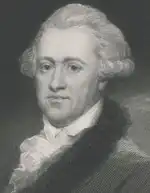
- Election year 1793
Research
Person
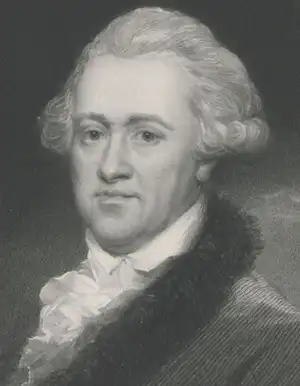
William Herschel was born on 15 November 1738 as the third child of the military musician Isaak Herschel (from Dresden) in Hanover. Four of his nine siblings died in infancy. At the age of 14, Herschel joined the Hanoverian Foot Guards, where he played the oboe and the violin. In 1756, his regiment was stationed in England for six months, where he learned English.
In 1788 he married Mary Pitt. In 1792, the couple had a son, John Frederick William, who also became a renowned astronomer. In 1793, Wilhelm Herschel attained British citizenship and changed his first name to William. His younger sister Caroline Lucretia (born in 1750), another famous astronomer, discovered several comets, reduced astronomical observations and published catalogues of hundreds of star clusters and nebulae.
William Herschel died on 25 August 1822 in Slough near Windsor.
A crater on the Moon was named after him in 1935. Moreover, a Martian crater was named in honour of Herschel and his son John in 1973.
Career
Following his arrival in England, William Herschel earned a living as a music copyist and music teacher. In 1759, he was tasked with establish a military band in Richmond, North Yorkshire. In 1761, he left for Edinburgh and a year later, transferred to Leeds. After several reassignments, he became the organist at the Parish Church in Halifax, West Yorkshire in 1766. He later joined the orchestra of the city of Bath (Somerset) and eventually became its director in 1780. In 1766, he also became organist at Bath’s Octagon Chapel, which enabled him to financially support his family in Hanover. In 1772, his younger sister Caroline Lucretia joined him in Bath, managing his household and singing at his concerts.
From 1773, Herschel became fascinated with astronomy. His sister Caroline and his brother Alexander frequently assisted in William’s sky observation sessions. He eventually started constructing his own reflecting telescopes – both for his own use and for sale – which became more and more precise as time went on. Herschel rented a workshop where he ground and polished mirrors with high precision, achieving astonishing focal lengths for that time.
In 1775, he compiled a catalogue of celestial objects, followed by another one in 1779. Herschel’s catalogue documented stars and confirmed the heliocentric configuration of the Solar System. In 1781, William Herschel discovered a new object in the Solar System, which he named Georgium Sidus (George’s star) in honour of King George III, now known as Uranus. In acknowledgement of this achievement, the British Royal Family endowed Herschel with an annual payment of 200 pounds, which gave him a degree of financial independence. This allowed Herschel to quit music and focus solely on astronomy.
Over the course of his studies he tried to assess the spatial structure of the Milky Way. In 1782, he published his essay “On the construction of the Heavens”, which described his image of the Milky Way as an extensive, branched accumulation of millions of stars. He also discovered the Uranian moons Oberon and Titania, as well as Saturn’s moons Enceladus and Mimas. Furthermore, he managed to provide evidence of the sun’s infrared radiation.
Honours and Memberships
William Herschel received a number of honours in recognition of his scientific achievements. He was a member of the Bath Literary and Philosophical Society (1780), the Royal Society London (1781), Foreign Member of the Goettingen Academy of Sciences and Humanities (1786), the American Academy of Arts and Sciences (1788), as well as the German National Academy of Sciences Leopoldina (1793). In 1816, he was knighted by the Royal Guelphic Order of the Hanoverian kingdom. In 1820, he was elected first President of the Royal Astronomical Society that he had founded with his son John Herschel.
Herschel received a Honorary Doctorate from the universities of Glasgow (1792) and Oxford (1796).