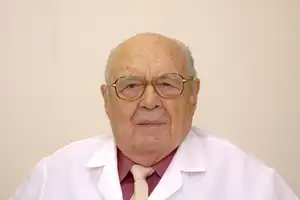
Prof. Dr. Bertalan Csillik (✝︎)

- Fachbereich Neurowissenschaften
- Ort Szeged, Ungarn
- Wahljahr 1983
Forschung
Bert Csillik is distinguished for important discoveries in the field of molecular neuroanatomy. He was first to visualize, with the aid of polarization microscopy, the molecular alterations of the receptor protein, which ensue during transmission of impulses in the neuromuscular synapse (1963). By demonstration of ultrastructural localization of the enzyme acetylcholinesterase with electron microscopy (1965), he established a school for molecular synaptochemistry in the Anatomy Department of the Szeged University Medical School (1972).
He discovered the law of transganglionic degenerative atrophy of primary central sensory terminals, which follows blockade of retrograde axoplasmic transport of nerve growth factor in peripheral sensory nerves (1978), and the unique regenerative synapto-neogenesis in the central nervous system of mammals, which follows re-establishment of retrograde transport of nerve growth factor in peripheral sensory nerves. On the theoretical basis of these, he developed (together with his wife, the clinical neurologist Elizabeth Knyihár-Csillik) the technique of transcutaneous iontophoresis of Vinca alcaloids for alleviation of intractable pain in chronic neuropathic patients (1986). Recently he discovered large, parvalbumin-containing GABA-ergic calyciform synaptic complexes in the reticular thalamic nucleus (2005), responsible for fine tuning of transformation of nociception into pain. He has implemented English- (1985) and German-language classes (1999) of anatomy, histology and embryology in the curriculum of the Szeged University Medical School.
He discovered the law of transganglionic degenerative atrophy of primary central sensory terminals, which follows blockade of retrograde axoplasmic transport of nerve growth factor in peripheral sensory nerves (1978), and the unique regenerative synapto-neogenesis in the central nervous system of mammals, which follows re-establishment of retrograde transport of nerve growth factor in peripheral sensory nerves. On the theoretical basis of these, he developed (together with his wife, the clinical neurologist Elizabeth Knyihár-Csillik) the technique of transcutaneous iontophoresis of Vinca alcaloids for alleviation of intractable pain in chronic neuropathic patients (1986). Recently he discovered large, parvalbumin-containing GABA-ergic calyciform synaptic complexes in the reticular thalamic nucleus (2005), responsible for fine tuning of transformation of nociception into pain. He has implemented English- (1985) and German-language classes (1999) of anatomy, histology and embryology in the curriculum of the Szeged University Medical School.